::SPATIAL 014 :: Sam Long | Laura Wolf x Chloe Alexandra Thompson | Zamy Maa | Hector Bravo Benard
Sunday, February 08, 2026
169 Bowery NYC
8:00 PM
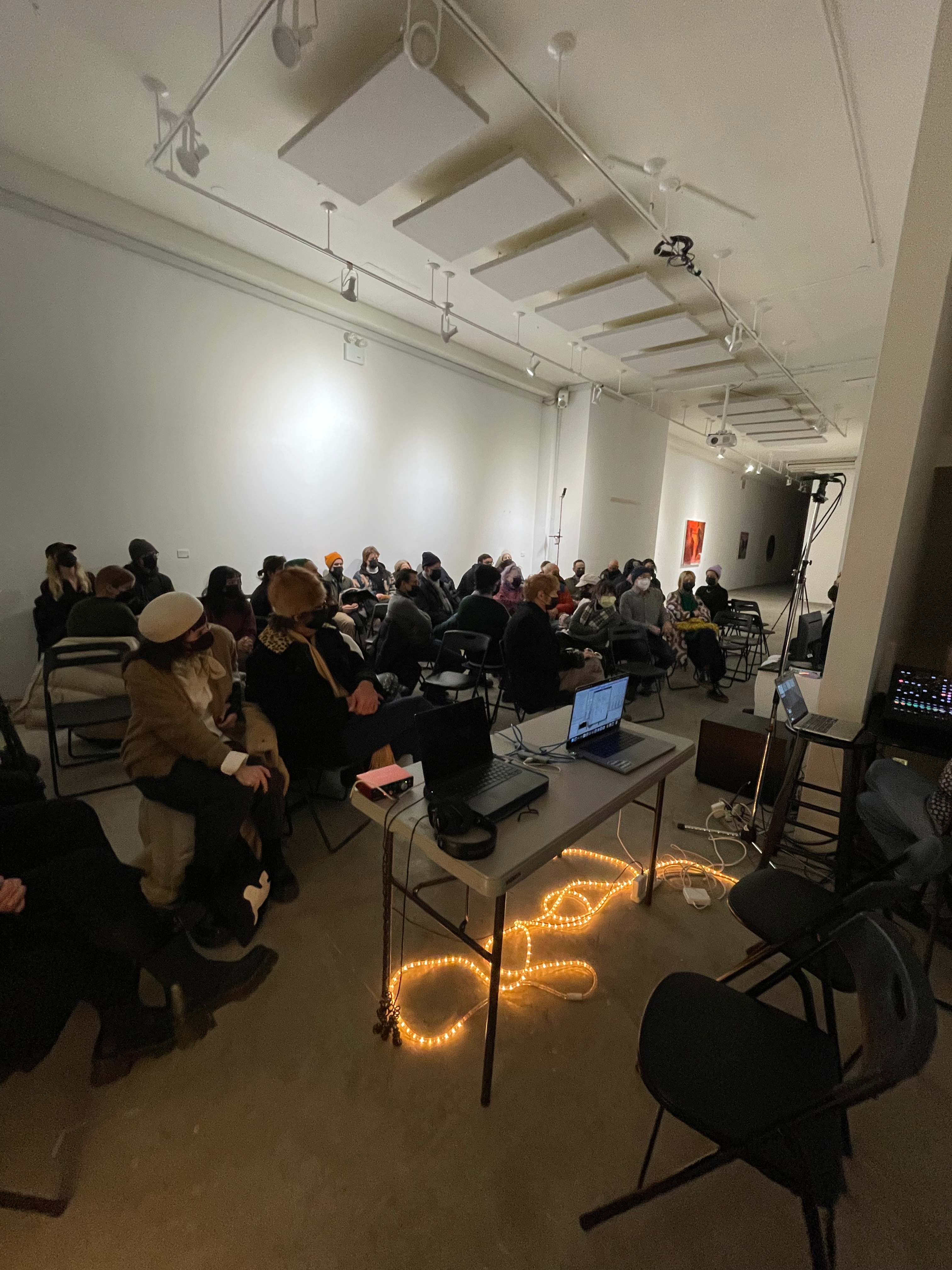
SPATIAL 014 :: will be a Covid-safer event with air purifiers from A.I.R. NYC and masks required. To protect the vulnerable and make this event more accessible.
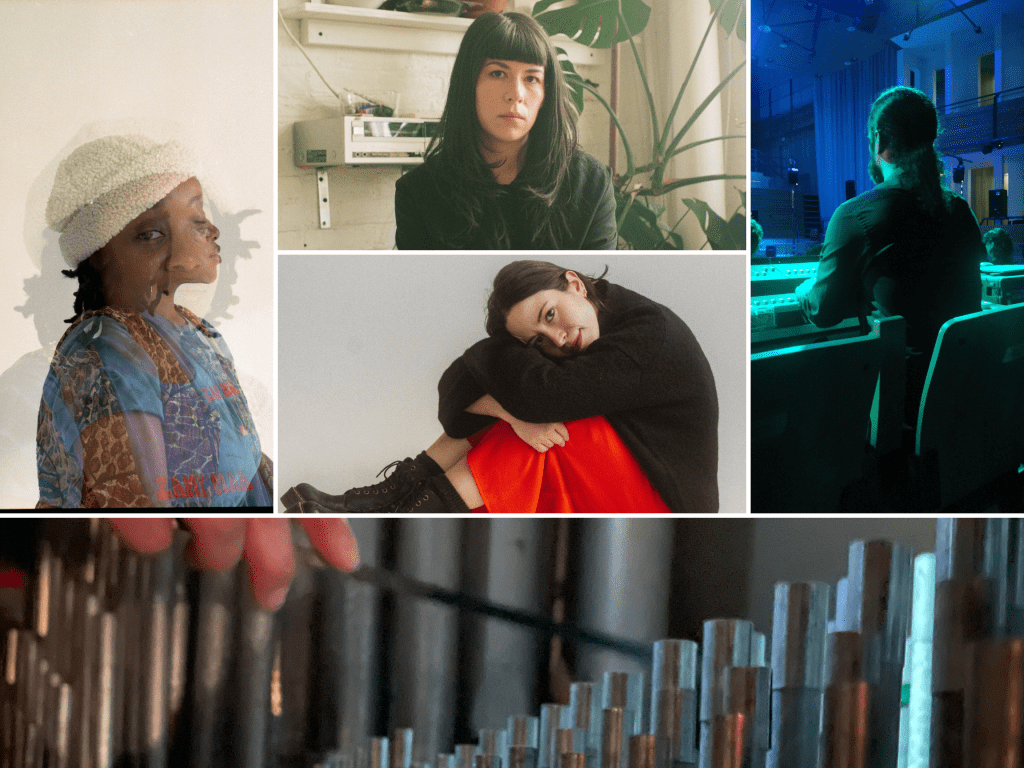
Sam Long :: “Respiration” is a fixed media piece composed on the pipe organ. In September 2022, I contracted a particularly nasty case of COVID with a multitude of complications that affected both my heart and lungs. For a period, I was undergoing a frankly disconcerting number of tests and procedures, and couldn’t help but draw a comparison between this and my work of tuning and repairing pipe organs. The pipe organ functions a lot like a human’s respiratory system, with chambers hidden from view pumping air into various tubes and pipes. In the course of my job, I test and fix these issues, much like doctors do for patients. The product of these repairs and corrections in a pipe organ is, of course, auditory, and usually results in the monolithic sound either deteriorating into white noise or haunting microtonal glissandi. I’ve assembled a collection of these sounds from various pipe organs I’ve tuned across New England, along with recordings from the various ekgs, echocardiograms, x rays, and CT-scans I underwent in 2022. With these recordings, I’ve tried to create the haunting and lonely experience of the Covid pandemic.
Laura Wolf x Chloe Alexandra Thompson :: What is the sound of one body listening to another? Music and sound elicit empirical changes to psychological response depending on tempo, timbre, key, and pitch. Using live biofeedback from a small group of participants, “Listening Bodies” explores how these physiological responses manifest as sound, and furthermore, how these sounds evolve and respond to each other.
Presented by Laura Wolf with Chloe Alexandra Thompson, “Listening Bodies” uses voltage meter and heart monitor feedback, acupuncture needles, custom hardware and creative signal processing to translate live biodata feedback into an evolving audio soundscape that captures the sound of bodies listening to each other. Audience members are encouraged to meditate on the response of their own breath and heartbeat, or to simply enjoy.
Zamy Maa :: Carry Me Home is an immersive spatial sound performance that explores longing, return, and the body’s memory of safety. Built from voice, bass, subtle harmonic layers, and environmental textures, the piece unfolds slowly, allowing sound to move around and through the listener rather than toward them.
The work draws on lullaby, prayer, and ancestral calling—gestures of being held, guided, or carried across distance. Carry Me Home invites listeners into a shared interior space—one that is less about destination and more about surrender. The performance asks: what does it mean to be carried, and how does sound remember what the body has forgotten?
Hector Bravo Benard (Remote) Program Notes ::
Nowhere (2022, 10:13)
Composed during the pandemic isolation, Nowhere uses sound sources from common household objects, layered with processed vocal samples and signals generated by chaotic systems. Techniques such as delay, filtering, and spectral processing were used to shape the material. The piece explores the paradox of feeling globally connected, yet physically isolated, being both everywhere and nowhere at once. Its spatial design underscores this tension, emphasizing presence and absence within a surrounding acoustic field.
Interlude (2022,9:57)
A contemplative break in a series of denser, noise-driven works, Interlude features slowly evolving textures and pulsating microrhythms. Sounds derived from household objects and chaotic generators are processed through delays, resonators, and spectral tools, forming delicate layers. The piece offers a quieter, introspective moment that builds to a noise peak before dissolving again. Its restrained but gradually building up dynamics and spatial flow serve as a perceptual pause, a brief opening within a broader, more turbulent sonic landscape.
In the Fog (2023, 10:58)
This work uses chaotic synthesis and feedback-based signal processing to create dense, slowly shifting sonic textures. High-frequency resonances and layered atmospheres form a rich, immersive sound mass. The piece emphasizes spatial and timbral counterpoint, with grain clouds and diffused gestures scattered through the 3D field. These sounds gradually unfold, producing complex interference patterns and micro-rhythms. The title reflects the experience of being enveloped by a slowly drifting fog, evoking a space where perception blurs and time stretches.
::
About the Artists
Samuel Long is a Boston-based composer and improviser, composing in extended just intonation. He has written for ensembles including the Lydian String Quartet, Talea, Hypercube, and Lamnth. Samuel was one of 10 composers selected by IRCAM to perform with and study under Bernhard Lang at the 2022 ManiFeste festival in Paris. In 2024, he was a fellow at the Etchings Festival in New York City and gave the first live performance on a 1960s Buchla synthesizer as a fellow of the Leonard Bernstein Festival of the Arts. He performed at the 2025 Darmstadt Summer Courses. He received an MFA in Music Theory and Composition at Brandeis University, where he was awarded the Fischer Prize for Excellence in the Creative Arts. He studies privately with La Monte Young and Catherine Lamb, and currently attends Boston University for his DMA.
Laura Wolf is a vocalist, cellist, producer and maker who composes and performs under various aliases across the genres of contemporary-classical, sound, pop, rock and film. With roots in classical voice and cello, Laura’s composition and production practice is a playful and tactile laboratory where she explores how grid-based cerebral precision and intuitive sound can co-exist. Her sound and technology projects examine perception and evolving relationships between space and sound. Her work has been featured on NPR, Paste and Stereogum. She holds a B.M in Voice and Opera from Northwestern, is a Wurlitzer Foundation fellow and is a member of the Recording Academy.
Chloe Alexandra Thompson is a Cree interdisciplinary artist, technologist, director and composer. Her practice explores listening as a way of knowing and relating which is shaped by Indigenous resonance, spatial perception, and embodied vulnerability. Working with psychoacoustic tones, algorithmic systems, and sculptural spatialization as materials, she composes spaces that shift awareness, inviting deep relational encounters between bodies, technologies, and the land.
Zamy Maa is a Brooklyn-born singer, producer, and sound artist whose work explores listening as a practice of remembrance, healing, and return. Rooted in Afro-diasporic spirituality, jazz, soul, and experimental sound, her music blends intimate vocals, layered harmonies, and low-frequency textures to create immersive sonic environments that invite stillness and deep attention.
Trained in audio technology and self-taught through years of independent production, Zamy approaches sound as both craft and ritual. Her work is informed by ancestral memory, motherhood, and the body as a site of knowledge, often using spatial sound and minimal arrangements to foreground breath, resonance, and emotional presence. Through performance and installation, she creates spaces where sound becomes a vessel for rest, reflection, and reconnection.
Originally from Mexico City, Hector Bravo Benard studied philosophy and music at the University of Victoria (Canada), and later at the Xenakis Centre (France), the Institute of Sonology and the Royal and Rotterdam Conservatories (Netherlands), the National Autonomous University of Mexico, the University of Washington’s DXARTS Center (USA), and the University of Birmingham (UK), where he received his Ph.D. He composes sound-based music for acoustic instruments, live electronics, and fixed media, with a focus on timbral and spatial elements, and natural phenomena such as non-linear dynamical systems. Some of his main teachers over the years include Agostino Di Scipio, Julio Estrada, Scott Wilson, Clarence Barlow, Paul Berg, Gilius van Bergeijk, René Uijlenhoet, Gerard Pape, Carla Scaletti, Michael Longton, Christopher Butterfield, Andrew Schloss, and Alex Dunn. His works have been presented internationally at events such as ICMC, BEAST FEaST, MA/IN, SEAMUS, Gaudeamus, NYCEMF, Sonorities Belfast, Espacios Sonoros, ACMA, FIMNME, Sound/Image Festival, and the Kyma International Sound Symposium. He currently lives in the Netherlands and Germany, working as an independent artist, researcher, and music software developer.
 NEW EAR ::