SPATIAL 016 :: Andrea Parkins | sound whimsy | Diane Barbé
Sunday, March 29, 2026
169 Bowery NYC
DOORS 7:30p | SHOW 8:00p
Andrea Parkins :: The Stray, Variation 3 (for 8 channels) is an electroacoustic composition through which Parkins highlights and implicates correspondences (or ruptures) that take place between gesture, sound and space; and embodied tensions between attempt and fluency. Andrea Parkins’ composition draws on Julia Kristeva’s psychoanalytically-based writing on abjection and the sublime in which she evokes the subjectivity of a migratory, dislocated (and sounding) body: a “stray”. This is a wandering entity who might at once engage or disengage with matter, place, and situation: “… an exile who asks ‘Where?’”.*
Parkins’ works are based on an accumulative process. With a focus on daily studio practice, she documents her ongoing improvisational/compositional experiments, developing gestural/embodied approaches to working with both sonic and visual materials. Over time, she builds an archive of sounds, amplified works on paper, and sonified objects and moving images: combining and then locating these elements in response to acoustic, physical and metaphoric space.
The Stray, Variation 3 is an adaptation of Parkins’ The Stray (2021). This 14-channel long-form work was composed in situ and then premiered at ROM for kunst og arkitektur in Oslo, as part of Parkins’ solo intermedia exhibition, Sonic Spaces for the Stray. For New Ear :: Spatial, Parkins presents an 8-channel version of the composition, specifically configured for Fridman Gallery’s octophonic cube.
* Kristeva, Julia (1982) Powers of Horror, An Essay on Abjection. New York: Columbia University Press.
sound whimsy :: Imprints, Eternal sees the listener as a spectator – taken through vignettes of a House that’s been long abandoned. However, affects of its storied past poke through a dense soundscape of creaking wood and rotting foundation. Each movement of the piece serves as a different room where keen listeners can hear the story of the House as a revenant – a place once full of humanity, levity, anger, and grief. It begins in the basement and guides the listeners upstairs through the kitchen and the once grandiose ballroom. From there, listeners are taken through a shattered greenhouse, a labyrinth of hallways, a tattered bedroom, and a waterlogged bathroom before finally guiding them up and out through the attic. The House, however vacant, is a glimpse into the complexity of life. It begs the question: when the intangible is left behind, where does it go? This piece uses field recordings, guttural vocal performances, and a wide variety of instruments to paint a vivid picture of ghostly decay.
Diane Barbé :: The piece Signe Singe, composed in the autumn of 2025, develops from a very old question: how do we know that a thunderstorm is a thunderstorm, an owl an owl, and a flute a flute? Between the forms emerging from the analog circuits of 1960s and 70s synthesizers and the voices hidden in the breath of wind instruments made by the composer, Signe Singe asks whether these sounds, too, “came from the earth.”
The composer warmly thanks the people who made this work possible and contributed their breath and help, including Pia Achternkamp, Christine Armengaud, Stefano Arrigoni, Irwin Barbé, Louise Boghossian, Audric Chauvin, Varoujan Chetirian, Pablo Diserens, Selu Herraiz, and Lisa Mondlane.
About the Artists
Andrea Parkins is a composer, sound artist and electroacoustic performer who engages with electronics as both material and dynamic process. Activating an array of sonic sources – acoustic and electronic instruments, amplified drawing tools, objects and surfaces; electronic feedback, and custom-built software and hardware – her work explores connections and slippages between the body, materiality, sound, site, and space.
Parkins’ projects include spatial sound and intermedia installations; performances and compositions; and scores for contemporary dance, experimental film and intermedia performance. Her work has been presented at the Whitney Museum of American Art, Experimental Intermedia, Kunsthalle Basel, Borderline Festival (Athens) and NEXT (Bratislava), and many more. Recent projects include her spatial compositions, “The Stray” (2021) premiered ROM for kunst og arkitektur in Oslo, and “The Stray II” (2023) at The Nordic Biennale of Contemporary Art in Moss, Norway; her two-part installation, “Two Rooms from the Memory Palace/The Third
Room” (2015-2021): and “Two Rooms, Variation 1, for 40 loudspeakers and Solo Performer” (2016), premiered at Akousma Festival , Montreal. Parkins has long been known for her pioneering approach as an improvisor, in which she uniquely combines her electronically-processed accordion’s textures and timbres with bursts of electronic feedback, amplified object sounds, and live-processing from her custom-built instruments. She performs internationally as a solo artist and in collaboration with artists such as Ute Wassermann, Magda Mayas, George E. Lewis, The Necks, choreographer Vera Mantero, and filmmaker Abigail Child, among others. Her recordings have been published by Superpang, Important Records, Confront Recordings, and Infrequent Seams, among many others. She has been an invited resident artist at Rauschenberg Residency, Elektronmusikstudion-EMS Stockholm, Harvestworks (NYC), and Q-02 in Brussels. Parkins’ projects have received support from American Composers Forum, NYSCA, French-American Cultural Exchange, the Norwegian Artistic Research Programme, MusikFonds (Germany), and Berliner Förderprogramm Künstlerische Forschung.
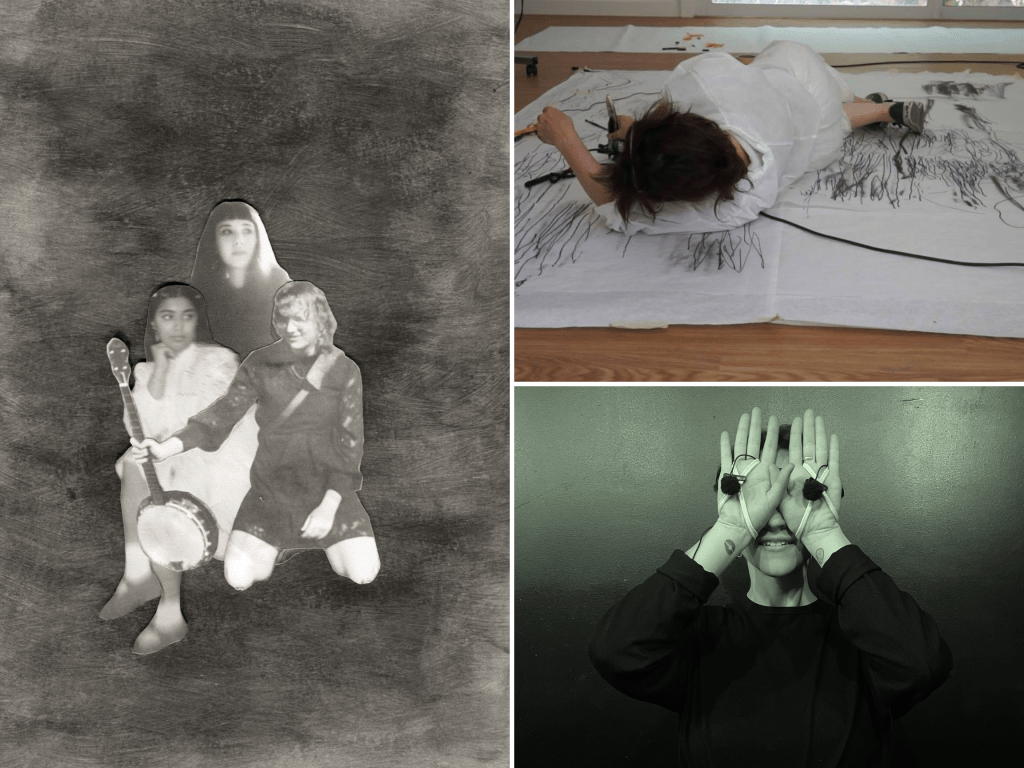
Teya Weir, Opheila Badretdinova, and Advika Krishnan are multidisciplinary artists and musicians working out of Boston Massachusetts. Coming from different backgrounds, they met as students at the Berklee College of Music and began working together after taking the same class in multichannel audio. The three of them share a love for stories and folklore that is reflected in their individual work in various installations, records, and performances across Boston. This common thread between them inspired them to work together to cater experiences that represent the sum of their individual experiences, ruminations, and concepts of the world around them.
Diane Barbé (she/they) works at the intersection of experimental music and anthropology, delving into multiple practices of sound from instrument building, electroacoustic composition, field recording, teaching and writing. Her ongoing project The Alien Kin develops collective music workshops with handmade wind and percussion instruments, exploring imitation and sonic mimicry as possibilities for accessing more-than-human modes of representation. Her last album, Musiques Tourbes, came out on Forms of Minutiae in the autumn 2024, unravelling a mixture of field recordings and additive analog synthesis, building together a swampy universe of small critters. Diane collaborates with Laure Boer on the radical improvisation duo Arbore and is part of the quatuor Feu Fou. She also performs solo in experimental music festivals and venues across Europe, builds sound installations and instruments, produces for films and documentaries, and recently composed Signe Singe, an electroacoustic piece composed for the multichannel acousmonium of GRM-Paris.
 NEW EAR ::