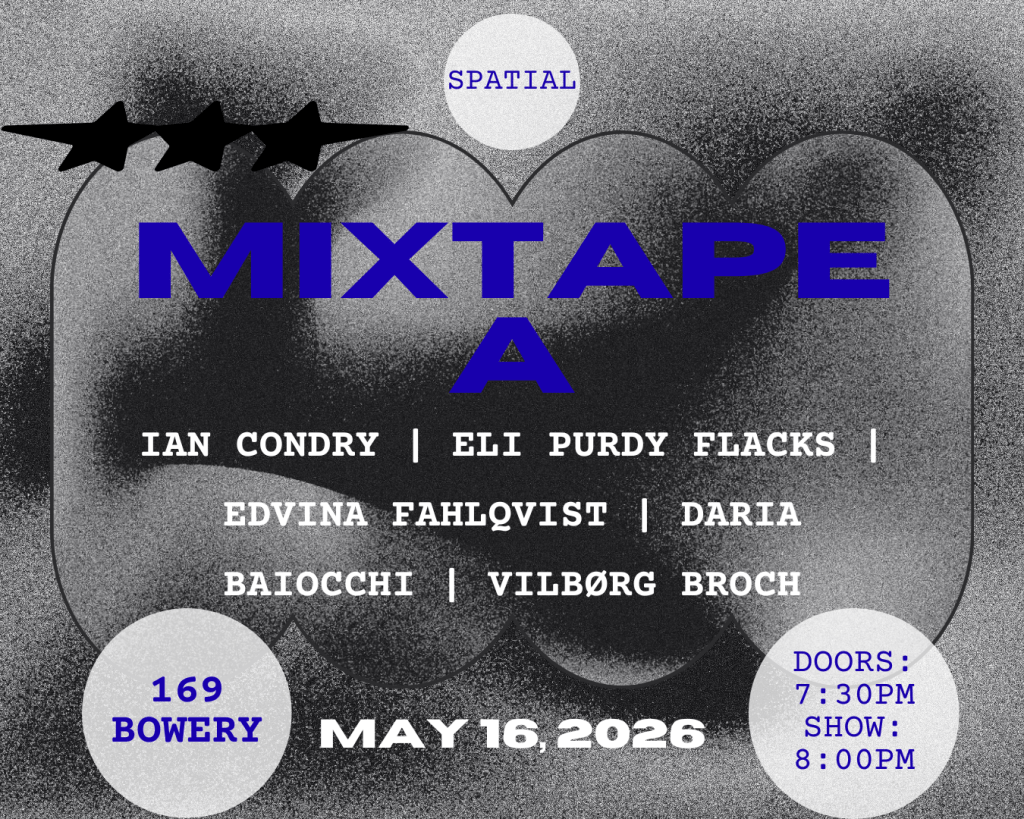
MIXTAPE A :: Ian Condry | Eli Purdy Flacks | Edvina Fahlqvist | Daria Baiocchi | Vilbørg Broch
Saturday, May 16, 2026
169 Bowery NYC
DOORS 7:30p | SHOW 8:00p
Leftroman is the artist name of Ian Condry, professor at MIT and founder of the MIT Spatial Sound Lab. He will be presenting a preview of his upcoming quadraphonic album “Phantom Center” to be released in the summer of 2026. The album is a collection of electroacoustic works that aim to evoke latenight listening bars in Tokyo. The songs are designed for playback on multichannel speaker systems and will be specially mixed for the octophonic cube at Fridman Gallery.
Eli Purdy-Flacks :: Four Worlds: Anthropocene is a sectional piece which explores nature and technology from 4 different angles. Each section functions as a world by itself, isolated, and also simultaneously exists in relation to all other sections.
Infinitely sustainable, adapting and evolving at a speed so slow we cannot wrap our minds around it, nature’s interlocked systems of life and death ask no one of anything. Through the first section of my piece, I explore nature untouched. To start with, this section provides context for all subsequent worlds. It asks is there anywhere to go from here? Are we progressing or regressing? Is there even such a thing?
The next section explores the concept and promise of technology. The undeniable, addicting feeling of discovery, the realization of ideas and the unlocking of new experiences. This world exists separated from nature and imagines a place where technology neither harms nor benefits anything else, because there is nothing else. This allows the listener to experience technology separated from how we experience it in our world today. In this world, technology doesn’t have an environmental impact because there is no environment. It presents the listener with the beautiful and powerful elements of technology without the negative aspects that are associated with it in today’s world, so the listener can process why it is so special.
The next section brings both these elements together to represent a world much like our world today and a potential future. Technology provokes nature, destroying ecosystems for the purpose of innovation and excess. Nature fights back through environmental catastrophes that leave cities ruined. In this section, the sound of oil rigs is drowned out by massive floods. The relationship between technology, nature and humanity is unsustainable and toxic. Racist ideologies are perpetuated through online echo-chambers which use technology as a means of destruction. The spirit of technological innovation explored in the previous section is perverted to create weapons made to take human life and cause destruction in the natural world. The chaos is hard to process and accept and yet it is as real as anything else. A false comfortability floats in the air like a poisonous gas made of inaction and complacency. What makes each element individually beautiful can be seen in this world, however it is blurred.
The last section allows both elements to not only flourish but lift each other up. In this utopic vision, technology is used as a sustainable means to innovate, explore and assist the natural world. In this world, the lines between all the contrasting elements explored in previous sections begin to blur. This final section could be interpreted as the future that must exist to preserve the beautiful features of nature, humanity, and technology without sacrificing anything. This world is one that allows everything to bring the best out of everything else.
Daria Baiocchi, “GELB” :: Wrapped in noise, the opening of this work draws the audience into a raw and primordial environment, where sound emerges as an unstable matter in constant transformation. An evolving texture unfolds gradually, immersing the listener in a suspended sonic space in which density, grain, and resonance continuously shift. From the very beginning, noise is not treated as an absence of form, but as a living substance—an acoustic soil from which the entire structure of the work originates.
The composition is articulated in a series of sections bound together by a common fil rouge: the presence of pure sounds interwoven with varied repetitions of white noise. These elements act as both connective tissue and narrative device, shaping a journey that is at once abstract and deeply evocative. Repeated sonic gestures appear with changing envelopes, expanding, contracting, dissolving, and re-emerging in altered states. Through these transformations, sound becomes a vehicle for storytelling, recounting a lunar myth in which the sonic material itself assumes symbolic meaning.
In this mythological dimension, the moon functions as a distant witness, a silent reflector of memory and time. The sounds acquire reverberations and echoes that seem to originate from remote spaces, suggesting fragments of forgotten experiences. Memory does not appear as a linear recollection, but rather as a constellation of sonic traces—blurred, layered, and unstable. The material remembers itself, returning in altered forms, as if filtered through the passage of time. The memory of the sonic material is allegorically transformed and fragmented. It is interspersed with impulses surrounded by filtered elements that belong to a primordial matrix, evoking the origins of sound and matter. These impulses act as brief flashes of energy, punctuating the flow and disrupting any sense of equilibrium. Their presence introduces tension between continuity and rupture, between immersion and interruption, reinforcing the work’s dynamic internal balance.
Throughout the piece, a suspended sonic line emerges and recedes, swaying between tension and release. This shadow-like presence never fully resolves; instead, it oscillates between states, hovering at the threshold of perception. Its instability mirrors the fragile nature of memory and the elusive quality of myth. The listener is invited to follow this line not as a melody in the traditional sense, but as a trajectory—an invisible thread guiding the experience through layers of sound. The work ultimately unfolds as an exploration of transformation, where noise becomes narrative, repetition becomes memory, and sound becomes myth. By blurring the boundaries between material and metaphor, the composition constructs a sonic landscape that is both physical and symbolic. The audience is not merely asked to listen, but to inhabit a space where sound, memory, and imagination converge, suspended in a continuous state of becoming.
About the Artists
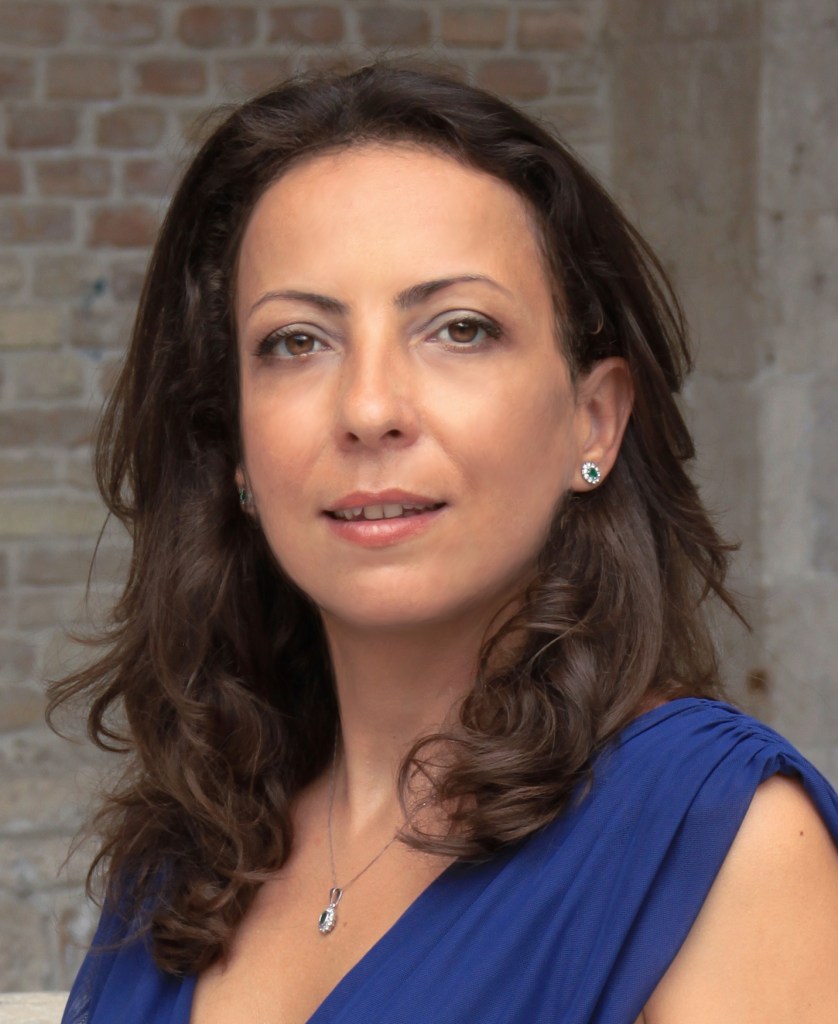
Daria is a composer and sound artist with an MA in piano, an MA classical composition, and an MA in electronic music. Her work spans concert music, sound art, and audiovisual composition, and has been performed in theaters and concert halls worldwide. Her music has also been broadcast by numerous international radio stations, including Holland National Radio and broadcasters in France, Portugal, the United Kingdom, and the United States.
As a composer working with electronics and sound art, Daria has received extensive international recognition. Her works have been selected and awarded in more than thirty countries, including Argentina, the Netherlands, Ireland, Germany, Italy, England, Hungary, the United States, Bulgaria, Poland, Lithuania, Canada, South Korea, Mexico, Sweden, France, Spain, Greece, China, Australia, and Slovenia. In 2010, she was awarded the title Cavaliere di Gaia by the Italian Ministry for her work Piano Inside, which marked a significant moment in her international career.
In 2011, she was selected for the “Open Doors” project at the Karlsruhe University of Arts and Design, winner of the MitOst Award in Berlin, and her work was presented at festivals in Berlin, Dublin, and Uden. Her piece Ombre was widely featured in 2012 at international festivals such as “120 Hours for John Cage” (New York), the International Festival for Electronic Innovation (Leeds), and Mediawave (Hungary). In 2013, her composition Beat Impulse for contemporary dance was selected by the Venice Biennale.
Between 2014 and 2018, her works were presented at major international events in Europe, the Americas, Asia, and Australia, including the New York Electroacoustic Music Festival and the International Symposium on Electronic Art in Vancouver. As a composer for video art, her music has accompanied award-winning works exhibited worldwide and broadcast by International ART TV. Daria is currently Professor of Harmony and Music Analysis at the “Pergolesi” Conservatory of Music, as well as Professor of Sound Design at the Macerata Academy of Fine Arts.
Eli Purdy-Flacks is a New York-based music producer, recording artist, engineer, and sound artist. Originally from Toronto, Canada, Eli got his start in the now disbanded hip-hop collective Library Trap. During these early years, Eli developed a unique sound combining gritty, hard-hitting grooves and sound-design with rich, jazz and soul-influenced harmony. This combination has persisted throughout all of his ventures and acts as a north star connecting his vastly differing projects.
Eli’s first solo album Keep a Light Shining (2024) explored these sonic themes further while experimenting with a myriad of other techniques such as granular synthesis and abstract song structure. The project was a therapeutic reflection, in which Eli processes tragedy including his father’s Parkinson’s diagnosis. The album attempts to turn uncertainty and pain into light, hope and acceptance.
Since graduating from Berklee College of Music in 2024 with a B.M. in Electronic Production and Sound Design, Eli has stayed active. His work has been featured at the Lincoln Center in Nona Hendryx’s Dream Machine Experience, and he has worked with major artists including Roberta Flack (no relation), Cory Henry, Max B, Nile Rodgers, Ghais Guevara, October London, and Jerry Barnes.
As a self-taught musician, Eli continues to grow and incorporate new techniques and philosophies into his creation. He is currently working on two major projects in 2026, a new solo project and a collaborative effort with the extremely talented artist/producer Kylos.
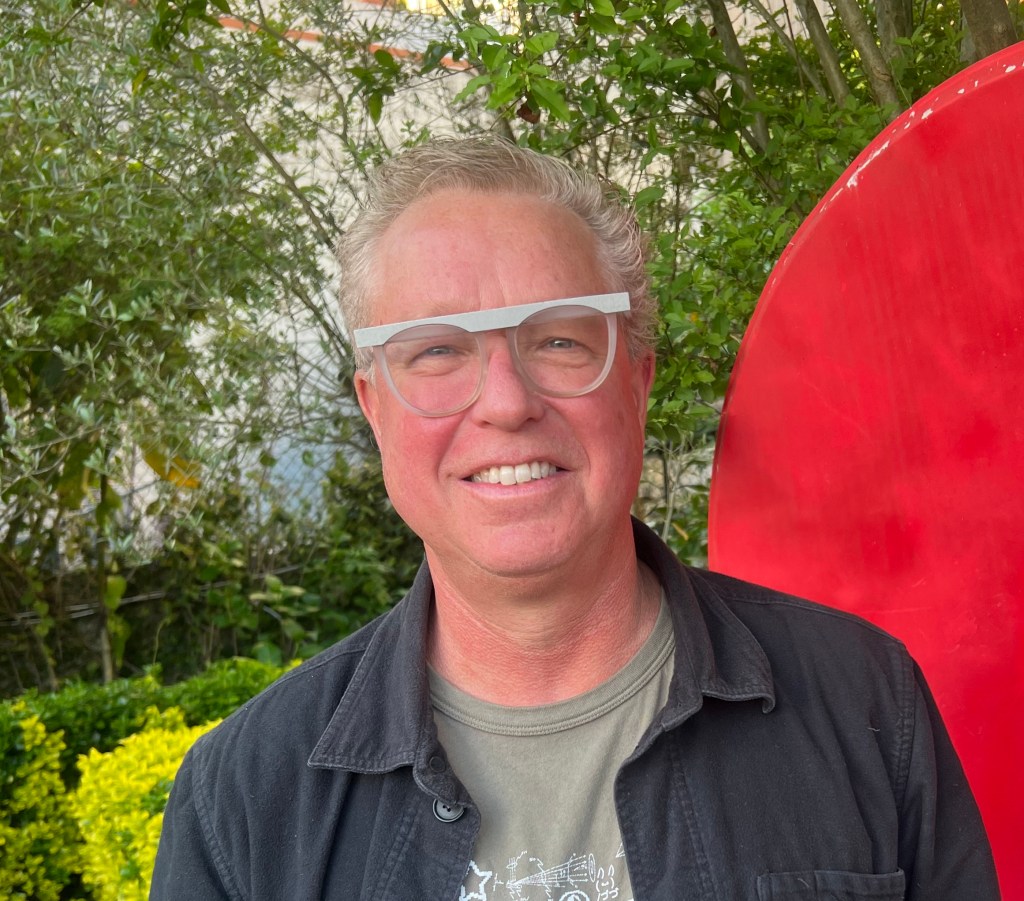
Leftroman (aka Ian Condry) is a musician and professor of cultural anthropology at MIT in the department of Comparative Media Studies & Writing, where he has been teaching since 2002. He makes multichannel music to highlight the limits of headphone playback and to explore the diverse potentials of spatial audio for collective listening in public. He founded the MIT Spatial Sound Lab in 2019 as a community studio for exploring the social possibilities of spatial sound. Along with Lab co-organizers Nelly Kate and Justin Looper, they present workshops, listening sessions, and an annual festival and conference Dissolve Music @ MIT each October. The Lab is also a founding member in the Boston Spatial Sound Community, a new initiative connecting Berklee, MIT, Harvard, and Emerson colleges. He is the author of two books that explore globalization from below: “Hip-Hop Japan” and “The Soul of Anime.” For the past eight years, he has hosted the radio show “Near & Far” on WMBR 88.1 FM Cambridge, MA.
More info on Ian Condry / Leftroman’s music, radio, writings: https://linktr.ee/iancondry
More info on MIT Spatial Sound Lab: https://spatialsoundlab.mit.edu