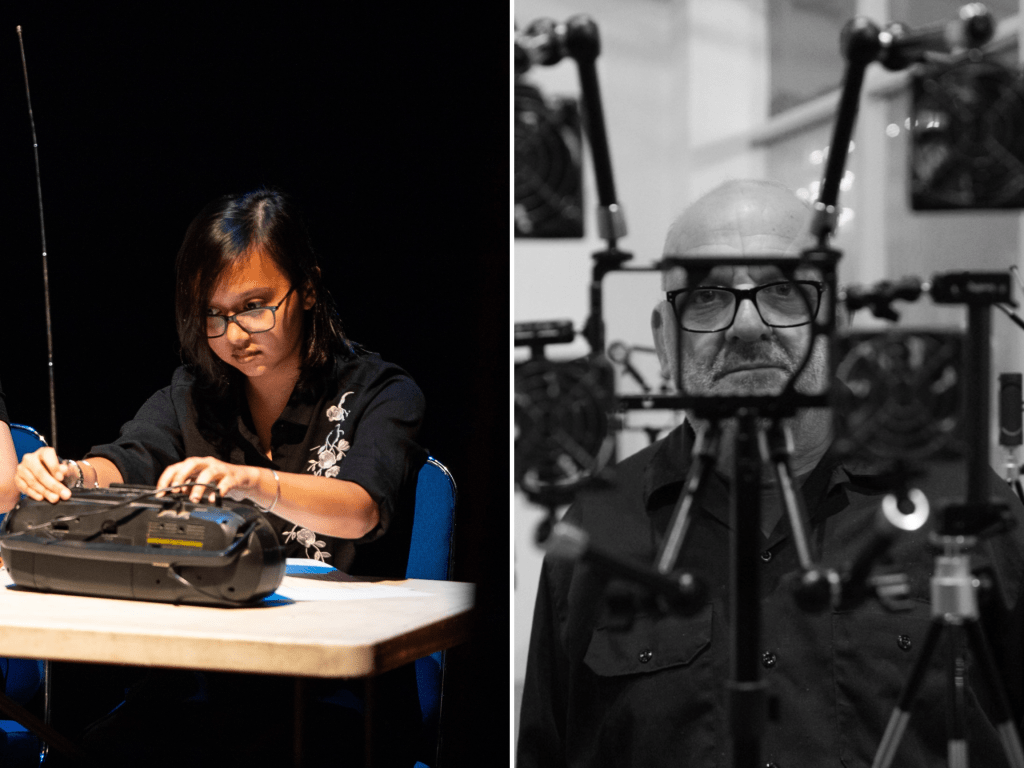
SPATIAL 020 :: Tao Ho | SPATIAL MIXTAPE B
Sunday, July 19 28, 2026
169 Bowery NYC
DOORS 7:30p | SHOW 8:00p
Tao Ho
眠/咒 – Sleepless Sleep is an improvisational sound practice by Tao Ho.
Between 眠 (sleep) and 咒 (incantation), the work inhabits a fragile space where rest and unrest quietly coexist. Sounds are allowed to linger, drift, repeat, or fall away. Small changes gather over time. There is no urgency to resolve them.
Perhaps 眠 (sleep) is not about sleep, but about a moment when the body no longer has to keep pushing forward.
The work simply remains.
SPATIAL MIXTAPE B
mira rizki ::
‘Napak Tilas’ means a journey to trace back the paths of someone to reflect on important past events and connect them to present realities. This sound installation consists of two speculative soundscapes that explore the sonic environment of the events of Jakarta in May 1998 and Gwangju in May 1980, alongside a third soundscape that juxtaposes both cities. The “Jakarta” composition is a speculative soundscape of the 1998 Indonesian riots, composed using present sound materials from Gwangju and shaped by historical published data from the actual events.
The work is intended to highlight the similarities between the riot caused by the monetary crisis in Indonesia (specifically in Jakarta) and the democratic uprising in Gwangju, showing how these patterns resonate into other events with a similar pattern and similar sound ecosystem. This is a manifestation to get to know how our perception is shaped by past events, which are presumably designed by the authorities.
Ana Gamboa ::
Lúmina is an electroacoustic work that weaves together travel recordings with fragments of anime sound to construct an imaginary space where the everyday and the fictional intertwine. Part of the sonic material was collected during a journey to Nuevo Rocafuerte, a small Amazonian village on the banks of the Napo River, reached after a fifteen-hour boat trip. Sounds of rain, birds, and daily life are combined with external materials, creating a constantly shifting soundscape.
The piece explores listening as a form of displacement, where memory, media, and environment overlap. Through layering and transformation processes, Lúmina blurs the boundaries between documentary and imagination, inviting the listener into a hybrid acoustic territory. The work was developed during a residency at the Institute for Computer Music and Sound Technology (ICST) at the Zurich University of the Arts.
Javier Chan ::
The story of the “舞獅”, the Lion Dance, in Cantonese folklore is a story about a mythical monster that terrorizes villages on the eve of every Lunar New Year. In a faithful act of solidarity, the villages banded together to create a colourful costume, resembling that of a fierce dancing lion. Accompanied by loud noises and the traditional music of cymbals and drums, their dance was able to ward the great beast away. For many generations, rituals and performances like the Lion Dance have served as symbols of resistance, remembrance and community for people all across the world. They are bound not just by culture, but by shared struggle.
A Repository of Sonic Anecdotes is an ongoing project that explores the political potential of ritual and performance. The project explores the intertwining of practices of sound production, installation art, and interpretive dance as a collaborative medium to commemorate the memories of dissolved communities and their lost spaces amid the ever-developing, ever-expanding, and ever-urbanizing conditions of the metropolitan world. Centred on the Lower East Side neighbourhood, this research tells the story of how a once lively, vibrant, and culturally knitted neighbourhood fades into oblivion, by way of mass gentrification and spatial injustice.
This project is guided by a curiosity about the formation of “new” culture. A curiosity in: How can we create new practices, rituals, and traditions in a post-industrial metropolitan world? Not to replace the cultures and communities that have been lost, but to highlight the histories of their existence and struggle. With discussions of territory and belonging being at the forefront of Homelands’ research focus for this presentation, this project will ask audiences to consider the role of ritual and performance in the context of empowerment and preservation. How do performances become tools of storytelling to preserve culture and community? How do artistic practices come to serve as symbols of resistance? The outcome of this project will be the creation and presentation of a new form of ritualistic performance, a framework for a new culture of remembering and connecting with space.
Structurally, the project was organized into stages of Research, Experimentation, and Production. Including processes of: site research, archival studies, documentation, interviews, writing, drawing, field recording, sound production, object-scavenging, object-making, sculptural installation, and interpretive choreography. This project culminated in a performance at Columbia University, with Harlem Dance Theatre dancer Elias Delano Re.
For New Ear ::SPATIAL, the presentation is a 6-minute sound piece consisting of three distinct movements that were composed for the performance. The piece itself involved several experiments in sound production, recording and “sound-making”. One key element of the sound production involved the recording of improvised instruments, which were made by rebuilding scavenged and unused objects such as old furniture and pipes found at the site. Through different trials of sampling and modulation testing in the sound production, the result was the creation of a sound palette that captures the textural and material qualities of a space lost to time, transforming into something new.
About the Artists
Tao HO is a sound artist and photographer based in New York. His improvisational sound practice explores listening as a way of attending to the subtle relationships between bodily perception, emotion, and space. Working primarily through live improvisation, he creates quiet sonic environments where repetition, instability, and sustained attention become ways of remaining with
experiences that resist immediate resolution.
Mira Rizki is a multidisciplinary artist based in Bandung (ID), working primarily with sound and interactive devices. Sensitive to the processes of sound-making and listening, her practice explores how different backgrounds, environments, and memories shape individual auditory experiences.
Her work focuses on sound as a form of personal expression and a quiet political medium, examining how these thoughts exist within and against prevailing societal narratives. Through experiments with collective aural memory, sound-making process, and soundscapes, she creates immersive aural experiences that invite listeners to reconsider how sound is shared and embedded in our lives.
She is involved in several exhibitions, such as “ARTJOG: Ars Longa Generatio” at Jogja National Museum [Yogyakarta] 2026, “Chapalang” at ArtSpace@Helutrans [Singapore] 2026, “Menggodam” at Ilham Gallery [Kuala Lumpur] 2025, “There is No Center” at ROH Project [Jakarta] 2025, Indonesia Pavilion at Gwangju Biennale 2024 (as a contributor artist) and “Walking Wandering” 2023 at Asia Culture Center (ACC) [Gwangju], “Present Continuous” at MACAN museum [Jakarta] 2021, and “Bandung Contemporary Art Award #6” at Lawangwangi Creative Space [Bandung] 2019. She also had her residencies and exhibitions at Aomori Contemporary Art Centre (ACAC) in Aomori [Japan] 2019, and Rumah Tangga in Depok 2025.
Ana Gamboa is an Ecuadorian composer, cellist, and sound artist working across electroacoustic music, free improvisation, and experimental practices. Her work explores sound as a space of hybridity, engaging with memory, territory, and contemporary listening. Her work has been presented in festivals, residencies, and concert series across Latin America, Europe, and the United States. She has received several recognitions, including the 1st Prize Marta Lambertini for Symphonic Orchestra (Argentina, 2025), the 3rd Prize in Composition from the National Arts Fund (Argentina, 2024), the CIME Residency Prize (under 35 category, 2023), the Ibermúsicas Award for Composition and Premiere (2021 and 2022), and was a finalist for the Luigi Russolo Prize (2024). Her recent residencies include ICST – Zurich University of the Arts (2025), Virginia Center for the Creative Art (USA, 2025), and Art Omi Music (USA, 2024). Alongside her artistic practice, she develops collaborative and community-based projects, contributing to the circulation of experimental music in Latin America.
Javier Yik-To Jay Chan is an architectural designer and sound artist born and raised in Hong Kong, currently based in New York City as a Master of Architecture candidate at Columbia University. His practice is a platform for experimentation at the intersection of his formal architectural training background and his interest in sound production and design. In his practice, Javier explores themes of environmentalism, urbanism and spatial injustice through projects that ask audiences to reflect on their relationships with the environment, the city, and its governing systemic institutions. Javier works through mediums such as sound, film, drawing,
sculpture, and space. Most recently, Javier was awarded the 2025 ARCHITECTURE MASTERPRIZE Student Landscape Architecture Award for his project: Tide Organ – A Sonic Intervention for Transspecies Engagement. The project was a conceptual design for a sound installation pavilion on the Hudson River Pier 45 park.